Safe: the sensors
Wipe both photo eye lenses near the floor and clear anything in the doorway.

Most garage door repairs come down to a few parts: springs, cables, rollers, the opener and its safety sensors. Send what the door is doing and a photo, and you get a written price before any work starts.
Get a quoteWhat fails
A door that will not lift is most often a broken spring. A crooked door usually means a cable or roller problem. A door that reverses is usually the safety sensors. Noise is usually rollers, hinges or lubrication.
How it goes
A repair request works best with details. The more the pro knows before arriving, the more likely the right parts come on the first trip.
Say what the door does, when it started and whether it still opens. Add a photo of the door from inside and one of the problem.
Ask for a written price that names the parts, such as which springs or how many rollers, before any work starts.
The technician fixes the problem, then checks the balance and the opener safety reversal.
No work starts until you agree to the price. Sending a request costs nothing.
Before anyone comes
Some checks are safe for anyone. Others are not. DASMA TDS-364 recommends testing the reversing mechanism and the photo eyes every month.
Wipe both photo eye lenses near the floor and clear anything in the doorway.
Test the outlet, reset a tripped GFCI, and replace the remote battery.
With the door closed and the opener released, a balanced door stays put partway up. DASMA TDS-174 describes it.
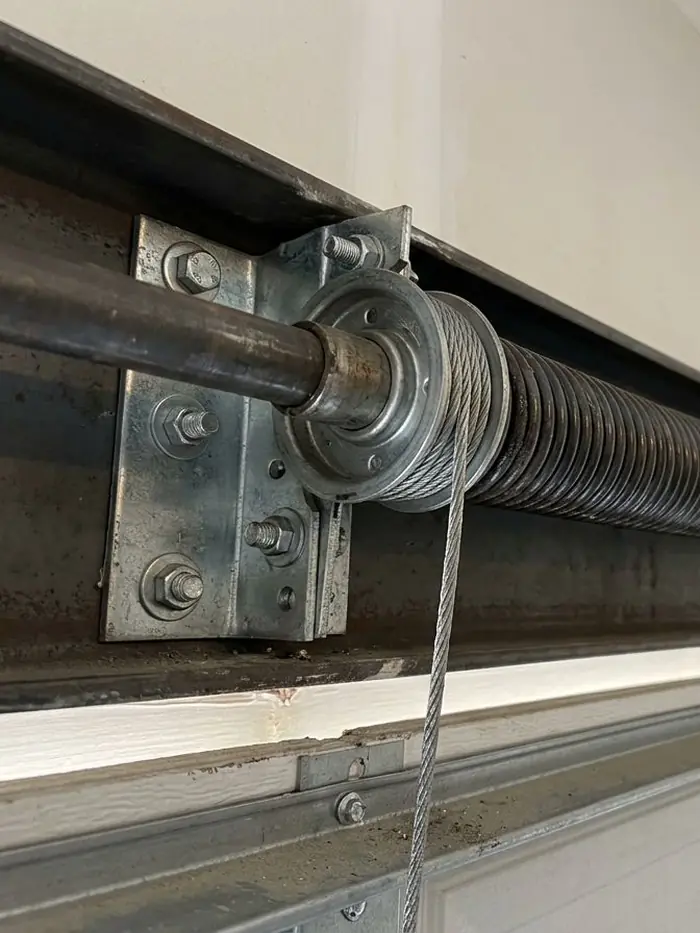
Do not loosen, adjust or remove springs, cables or bottom brackets.
Safety first. Never loosen, adjust or remove springs, lift cables, bottom brackets or anything bolted to them. They hold the weight of the door under high tension. DASMA TDS-151 reserves that work for trained door technicians.
Short answers
Short answers before you send anything.
Sending a request costs nothing. If a visit is needed, ask up front whether there is a trip or diagnostic charge. Ask for a written price before any work starts. The yes or no stays with you.
Not if a spring or cable is broken. DASMA TDS-167 says not to operate a door with a broken spring until the spring is replaced. If the door still runs smoothly and only makes noise, it can usually wait for a planned visit.
A photo of the door from inside, one of the problem, and the opener model if you know it. The opener model is on a label on the motor unit. Say whether the door is single or double, and steel or wood.
Yes, in writing. No work starts until you agree to the written price.
A loud bang, then a door too heavy to lift.
Frayed cables, a crooked door or rollers out of the track.
Hums, clicks, reverses or ignores the remote.
One dented or cracked section, not the whole door.
Replacement doors, sized and quoted for your opening.
Cold drafts, hot garages and worn bottom seals.
Door stuck open, hit by a car or bent by wind.
Shop, warehouse and rolling steel doors.
Guides and tools: Garage door troubleshooter, Opener fit estimator, Repair or replace helper, Wind, cold and weather alerts.
Send a request from any Grand Valley community on this list.
Send the details
Tell us what the door is doing. A phone number or an email is all we need to reach you.
If anyone is trapped or hurt, call 911 first. Do not try to free a door by loosening springs or cables.